
A building wrap is printed fabric covering all or part of a facade, usually while the building is under construction or refurbishment. Scaffold wrapping is the same idea applied to the scaffold itself: printed mesh laced to the standards so the whole structure becomes a single, enormous graphic.
I design and print both, at any size, and deliver free anywhere in the UK. Below is everything I go through with a client before a wrap goes to print, so you can specify one properly rather than guessing.
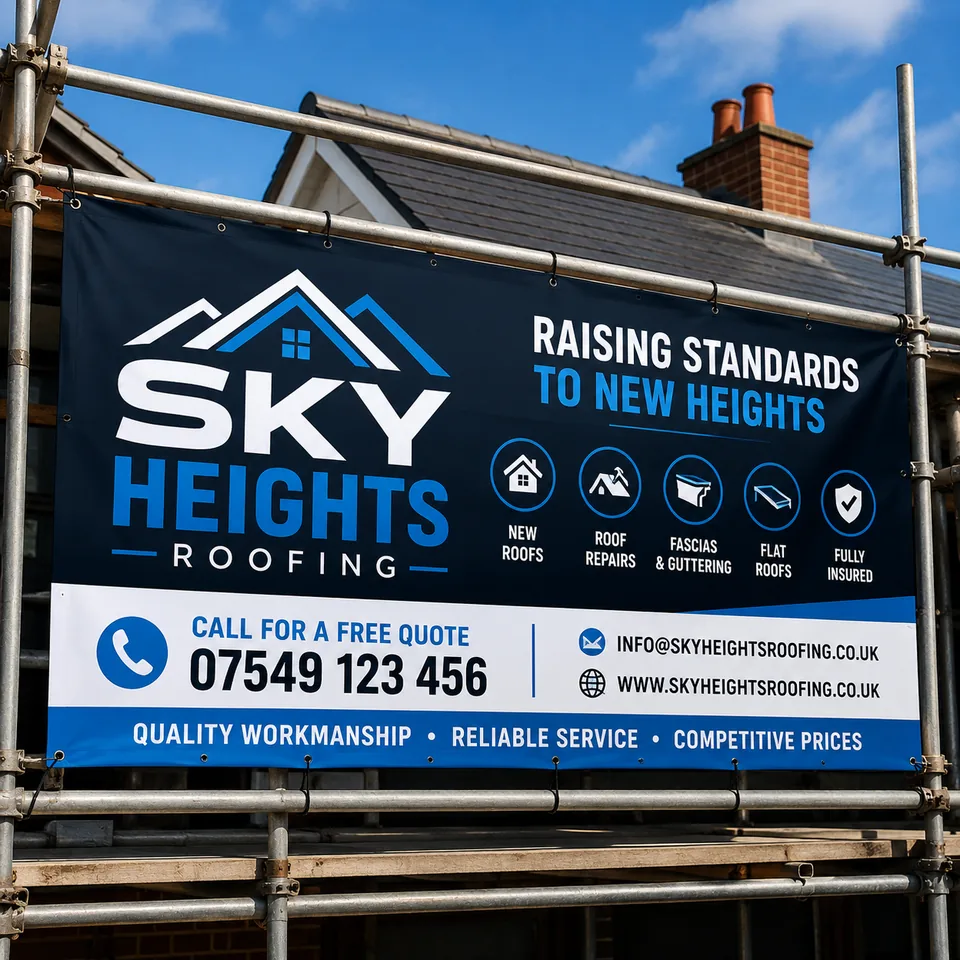
Why building wraps win bigger commercial work
Advertising nobody can scroll past
A wrapped building is the largest advert your business will ever run. On a busy road a single elevation can be seen by tens of thousands of people a week, for the whole length of the programme, with no ongoing media cost.
It makes a small firm look established
Clients and main contractors judge a firm on how the site presents. A properly designed wrap, with your logo, accreditations and a phone number at readable scale, says the job is being run by professionals.
Tidier, safer, better neighbours
Wrapping hides mess and containment sheeting, reduces dust escape and softens the impact on residents and neighbouring businesses. On sensitive sites that goodwill is often what gets the next contract.
Space for the whole story
Unlike a small banner, a wrap gives you room for a CGI of the finished scheme, the developer and contractor logos, hoarding-style graphics and a clear call to action for enquiries.
Materials: mesh, PVC or netting
Printed scaffold mesh
The standard choice for scaffold wrapping. Around 270gsm knitted or coated mesh, roughly 30 to 50 percent open, so wind passes through and loading on the scaffold stays manageable. Printed edge to edge and finished with reinforced hems and eyelets at 500mm centres.
Heavy PVC banner
Solid 440gsm to 650gsm PVC gives the punchiest colour and a perfectly flat finish. Best for hoardings, gable ends and sheltered elevations. Because it is not breathable it needs a proper wind assessment before it goes up on scaffold.
Full building wrap panels
For a whole elevation the artwork is tiled across multiple drops so it can be handled safely and replaced individually if one panel is damaged. Overlaps and bleed are built into the artwork so the joins disappear from street level.
Debris netting with print
The budget route. Lighter, more open netting with a simpler logo and message. Colour is softer and detail is limited, but it is cheap enough to justify on short programmes.
How a scaffold wrap goes from measurement to install
Measure the elevation, not the scaffold drawing
Get real dimensions on site, including the standing and lift positions where fixings will land. Note anything that must stay clear: access gates, hoists, windows that need light, fire escape routes.
Design for the viewing distance
The rule of thumb is 25mm of letter height for every metre of viewing distance. From across a dual carriageway that means letters half a metre tall. Two or three elements maximum per drop: logo, what you do, one number.
Check wind loading and permissions
The scaffold firm or their engineer must confirm the structure can take the extra load, and ties may need to be increased. Advertising on a wrap can also need local authority consent, especially in conservation areas, so raise it early.
Print, hem and eyelet
Artwork is tiled, printed with UV stable inks, then hemmed and eyeletted so it can be laced or bungeed to the standards rather than cable tied through the print.
Install and inspect
Lace from the top down, keep tension even, and add the wrap to the weekly scaffold inspection. Retension after the first storm and the wrap will comfortably outlast a twelve month programme.
Wind loading and consent, in plain terms
Anything fixed to a scaffold changes how wind acts on it. Open mesh lets air through, so the extra load is modest and most scaffolds cope with additional ties. Solid PVC behaves like a sail and needs the scaffold designer to sign it off, sometimes with extra ties or a heavier design. Never wrap a structure without telling the scaffold contractor what you are putting on it.
On consent: plain containment sheeting is generally fine, but a wrap carrying advertising can need permission from the local authority, and rules are tighter on listed buildings and in conservation areas. It is a short conversation with planning at the start, and a very expensive one after the print is made.
Mistakes I see on site wraps
- Artwork supplied at screen resolution, so a 12 metre drop prints soft and pixelated.
- Solid PVC used on an exposed scaffold with no wind assessment.
- Too much copy: three paragraphs nobody can read at 40mph.
- Phone number placed on the top lift where it sits above the eyeline.
- Cable ties pushed straight through the fabric instead of the eyelets, which tears the print in weeks.
- No consent checked on a listed or conservation area frontage.
Getting a wrap designed and printed
Send me the elevation dimensions, your logo and any accreditations you want on there, and I will design the artwork at full scale, show you a free mock-up on a photo of the site, then print, reinforce and deliver it free anywhere in the UK. If you also need matching hoarding graphics, site boards, signage or workwear branding, it all comes from the same artwork so the whole site looks like one job.